How to Shop at an Independent Stationery Store: A Paper Lover's Checklist
October 31, 2026 - Stationery

October 22, 2026 - Daily Practice

Most first fountain pens are bought for a slightly unreasonable reason: a notebook that deserves better than a ballpoint, a pen found in a desk drawer, the wish to slow down for ten minutes at the end of the day. That is fine. The pen only has to do one job — start when you touch it to paper, and feel pleasant in your hand for a page or two. Everything else is preference dressed up as expertise.
Four things decide whether a pen suits daily writing: the nib, how it fills, what your budget is really paying for, and how it feels in your hand after a full page. Here is how to judge each one without buying five pens to find out.
Nibs are graded by the width of line they leave: extra fine, fine, medium, broad, and beyond. The labels are not standardised. A Japanese fine is usually noticeably narrower than a European fine, and the same letter from two makers can differ by a hairline you will feel on the page. Treat the letter as a starting point rather than a specification.
For daily writing, fine or medium is the safe middle. Fine suits small handwriting, narrow rules and — importantly — ordinary paper, because it lays down less ink. Medium is more forgiving: smoother, less likely to feel scratchy on textured paper, easier to read at a glance. Broad nibs are lovely for letters and signatures, but they are thirsty, and a broad line on a 6 mm rule becomes a block of ink.
Write a paragraph in your normal hand with the gel or rollerball you already use, on the paper you actually take notes on. If your letters fill the line and your loops touch, choose a fine. If there is air left above and below your writing, choose a medium. Crude, but far better than judging by a photograph.
Steel nibs are stiff, reliable and perfectly capable of beautiful writing. Gold costs considerably more and adds a little springiness; it is a refinement, not a requirement. If you are unsure of your size, look for a pen whose nib can be swapped, so you can try a second width later without buying a second pen. And resist pressing. A fountain pen writes under its own weight — pressure is what turns a nib scratchy and eventually misaligns the tines.
How a pen takes ink affects your daily routine more than you might expect.
The beginner-friendly route is a cartridge pen plus a converter bought at the same time. You get the convenience for travel and the freedom of bottled ink at your desk, and you learn how the pen behaves with both.
At the entry level you can already buy a well-made pen with a steel nib that will write for years. More money buys consistency rather than magic: tighter quality control on the nib, better cap seals so the pen does not dry out overnight, nicer materials, a more refined filling mechanism. Those things matter, but none of them matter as much as a nib you like and a grip that suits your hand.
So set a ceiling before you browse, and spend the smaller part of it on the first pen. Leave room for one bottle of ink, one notebook that handles fountain pen ink, and possibly a spare nib. Skip the starter sets with a dozen cartridges in colours you will never use. No guide can tell you what is sensible for your budget — that is a conversation with your own bank balance, not with a shop.
If you can hold the pen before buying, do these. If you are ordering online, run the same checks on the first day and return the pen if it fails badly — most retailers allow it.
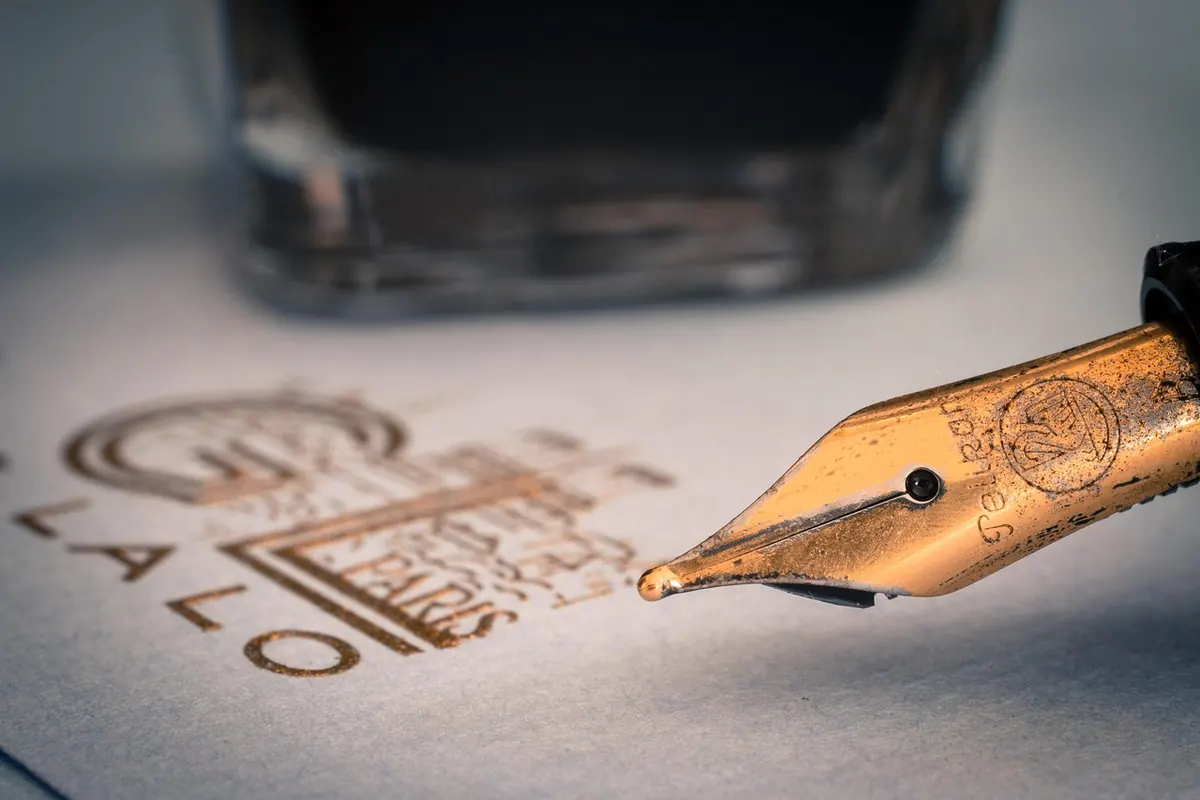
Hold the nib up to a window. The tines should meet evenly along the slit with no visible gap and no tip sitting higher than the other. If it scratches in one direction but glides in another, the tines are probably misaligned; exchange it rather than living with it.
A good pen on bad paper still disappoints. Thin copy paper feathers, bleeds through, and makes even a fine nib look messy. A notebook made for fountain pens — heavier stock, slight coating — will transform the same pen. If your line feels too wet, a drier ink helps; if the nib drags, a wetter one does. Start with two bottles at most, a blue-black and a black, and learn how they behave before collecting colours.
Choose a steel-nib pen in fine or medium, add a converter, one bottle of ink and one notebook you enjoy opening. Then use the same pen for two weeks without buying anything else. Write with it on the paper you really use, at the times you really write — the commute, the meeting notes, the ten minutes before bed.
Keep a short note of what irritates you. Too heavy? Line too wide? Cap works loose in your bag? That list is a better buying guide for a second pen than any review, because it is about your hand and your days. Flush the pen with cool water when you change inks, or every few weeks if you write lightly, and never let ink dry inside it for months. Do those small things and a modest pen will outlast your enthusiasm for shopping.
Photo: Ghinzo / Pixabay

A practical checklist for shopping at independent stationery shops: how to test paper, ask the right questions about...
A practical comparison of brush pens and dip pens for new calligraphers, covering control, setup, cleanup, cost and...
Copyright © 2026 Amanuense Ogni Giorno. All Right Reserved.